Key Takeaways
- RTP (Return to Player) is the percentage of all wagered money a slot is programmed to return over millions of spins — a 96% RTP means the casino keeps 4% as its mathematical edge.
- Volatility determines HOW those returns are distributed: low volatility delivers frequent small wins, high volatility delivers rare but potentially massive payouts.
- Two slots with identical 96% RTP can produce completely different experiences depending on their volatility — one may pay steady small amounts while the other produces long dry spells interrupted by large wins.
- The optimal slot choice depends on your bankroll size and session goals: smaller budgets suit high-RTP low-volatility slots, while larger bankrolls can sustain the variance of high-volatility games.
- Always check RTP and volatility in the game's info section before playing — reputable providers like Pragmatic Play, BGaming, and Play'n GO publish these figures for every title.
What RTP Actually Means (And What It Does Not)
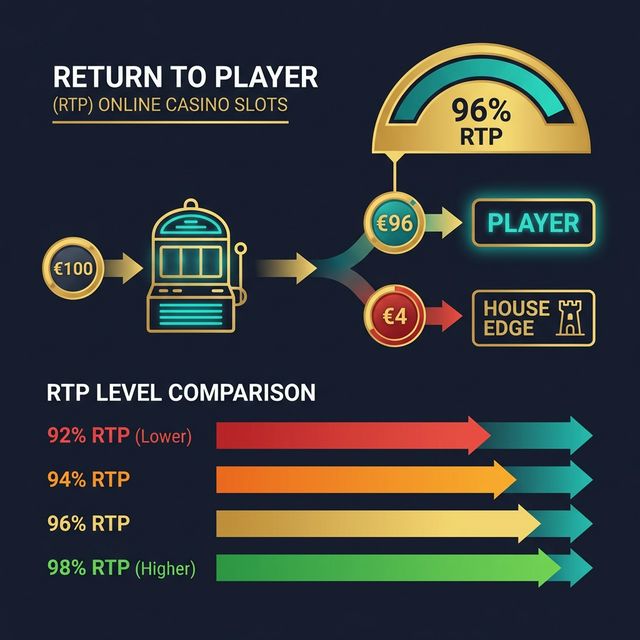
Return to Player is expressed as a percentage — typically between 92% and 99% for online slots. A slot with a 96% RTP is programmed to return €96 for every €100 wagered through it over its entire lifetime. The remaining €4 represents the house edge — the casino's built-in mathematical advantage that ensures long-term profitability.
But here is the critical detail that trips up most players: RTP is calculated over millions of spins, not over your individual session. In any given session of 200 or 500 spins, your actual return could be 40%, 150%, or anywhere in between. RTP is a statistical property of the game's mathematics, not a promise about your personal results. Think of it like a coin flip — you know the probability is 50/50 over thousands of flips, but in any sequence of 10 flips, you might get 8 heads and 2 tails.
What does this mean in practice? Over a sufficiently long period, a 96% RTP slot will cost you less than a 92% RTP slot. The difference sounds small — 4 percentage points — but it compounds dramatically with volume. If you wager €10,000 total across your sessions, the 96% slot has an expected cost of €400, while the 92% slot costs €800. That is double the expected loss for playing the mathematically inferior game.
Online slots generally offer significantly higher RTP than their land-based counterparts. Physical casino slots in Europe typically range from 85% to 92%, while online slots commonly sit between 95% and 97%. This is because online casinos have lower operational costs — no physical floor space, fewer staff, lower overheads — allowing them to operate with thinner margins. For the player, this means online slots are objectively better value from a purely mathematical perspective.
The best practice in 2026 is straightforward: never play a slot without checking its RTP first. This information is available in the game's help or info section, on the provider's website, and through independent databases. At CasinoLogin.gg, we include RTP data in our slot reviews precisely because it is the most objective measure of a game's value.
Volatility: The Number That Defines Your Experience
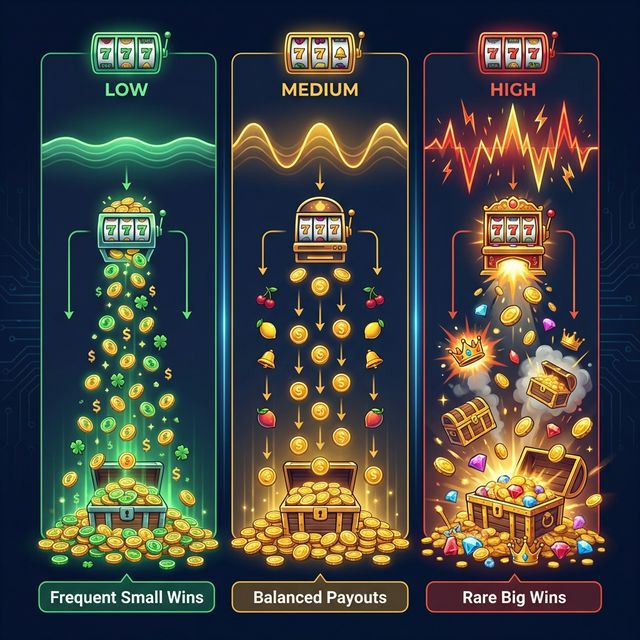
If RTP tells you how much money comes back, volatility tells you how it comes back. This is the metric that shapes the actual feel of your playing session — whether you experience a steady stream of small wins or long stretches of nothing punctuated by explosive payouts.
Low-volatility slots pay out frequently but in small amounts. You might win on 30% to 40% of your spins, but individual wins are typically 1x to 10x your bet. Your bankroll tends to hover around your starting amount, fluctuating gently in both directions. These slots are designed for extended play — they drain your balance slowly and refill it regularly, creating a consistent, predictable experience. Popular examples in 2026 include Starburst (NetEnt), Blood Suckers (NetEnt), and many classic three-reel designs.
High-volatility slots pay out infrequently but in large amounts. You might go 50, 100, or even 200 spins without a meaningful win, and then land a single payout worth 500x to 10,000x your bet. Your bankroll will drop steadily during dry spells and then spike dramatically on hitting a bonus round or multiplier combination. These slots deliver the thrill of chasing big wins, but they require patience and a sufficiently large bankroll to survive the inevitable losing streaks. Notable high-volatility titles include Gates of Olympus (Pragmatic Play), Bonanza Megaways (Big Time Gaming), and Dead or Alive 2 (NetEnt).
Medium-volatility slots sit between these extremes, offering a blend of regular small wins and occasional larger payouts. They represent the most popular category among recreational players because they balance entertainment value with reasonable bankroll sustainability. Titles like Book of Dead (Play'n GO), Big Bass Bonanza (Pragmatic Play), and Wolf Gold (Pragmatic Play) occupy this middle ground.
Unlike RTP, volatility is not always expressed as a precise number. Some providers rate it on a scale (1-5 or Low/Medium/High), while others publish a mathematical variance figure. The lack of standardisation across the industry is a legitimate frustration for players — and one reason why independent review sites like CasinoLogin.gg exist: to translate these varying metrics into consistent, comparable information.
The RTP-Volatility Matrix: How Both Numbers Work Together
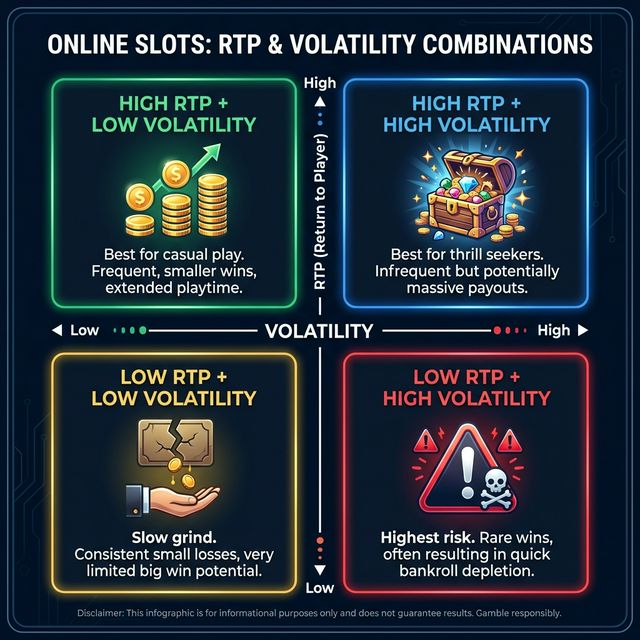
Here is where the real insight lives. RTP and volatility are independent variables — a high-RTP slot can be either low or high volatility, and the combination produces fundamentally different games.
High RTP + Low Volatility is the mathematically safest combination. These slots return the most money overall and distribute it in frequent, small payments. Your session experience will be predictable and your bankroll stable. This combination is ideal for players who want to maximise playing time on a fixed budget, who enjoy the rhythm of regular wins, or who are clearing bonus wagering requirements (where steady, low-risk play minimises the chance of depleting your balance before reaching the target). Example: Blood Suckers by NetEnt (98% RTP, Low Volatility).
High RTP + High Volatility is the choice for thrill seekers with adequate bankrolls. The long-term return is favourable, but the journey to get there is turbulent. You will experience significant swings — long losing runs followed by potentially life-changing wins. This combination offers the best risk-reward ratio for players chasing big multipliers, but only if your bankroll can absorb the extended dry spells. Example: Dead or Alive 2 by NetEnt (96.8% RTP, High Volatility).
Low RTP + Low Volatility is the slow grind. The game takes a larger house edge and distributes the reduced returns in frequent small amounts. Your balance will trend downward more predictably and more quickly than high-RTP alternatives. These slots are common in land-based casinos and in certain branded or licensed slots where the IP licensing cost reduces the provider's margin. They are not inherently bad, but they offer objectively less value per euro wagered.
Low RTP + High Volatility is the highest-risk combination. The game takes a large edge, pays infrequently, and when it does pay, the returns are substantial but may not compensate for the increased house advantage over time. Some progressive jackpot slots fall into this category — the base RTP may be 91-93% because a portion of every bet feeds the jackpot pool. The jackpot itself represents the potential for a massive payout, but statistically, you are paying a significant premium for that possibility.
Understanding this matrix allows you to make informed choices rather than selecting slots based on theme, graphics, or brand recognition alone.
Matching Slots to Your Bankroll and Playstyle
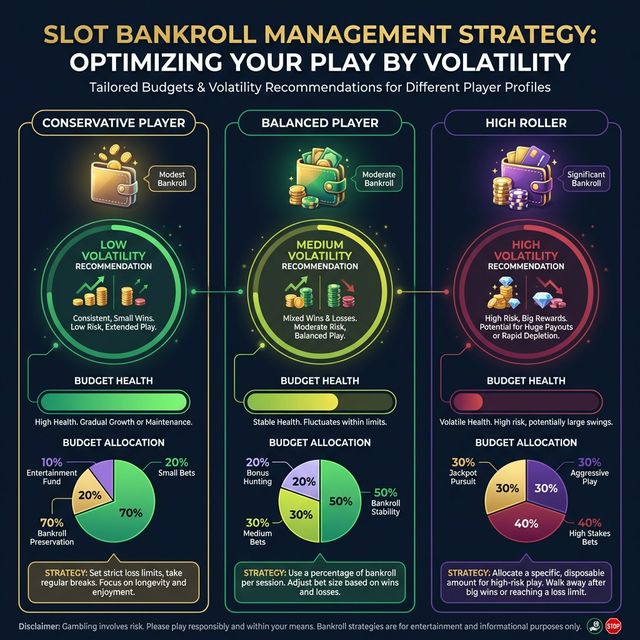
The practical application of RTP and volatility knowledge comes down to one question: which combination matches your budget and what you want from your session?
The Conservative Player — If your session budget is €20 to €50, high-volatility slots are mathematically hostile to you. With a small bankroll and high variance, the probability of depleting your balance before hitting a significant win is extremely high. Your best option is a high-RTP, low-to-medium volatility slot played at the minimum bet size. This maximises your number of spins, gives you the highest probability of experiencing bonus features, and provides the most entertainment value per euro. At €0.20 per spin with a €50 budget, you get 250 spins — enough to experience the game's full mechanics. On a high-volatility slot at the same stake, you might exhaust that budget in a joyless streak of 250 losing spins.
The Balanced Player — With a session budget of €100 to €300, you have enough cushion to explore medium-volatility slots comfortably and can take calculated shots at high-volatility games with smaller bet sizes. The key strategy here is proportional betting: allocate 70% of your budget to a medium-volatility game at a comfortable stake, and reserve 30% for a higher-volatility game if you want the thrill of chasing a bigger win. This approach ensures you get consistent entertainment from the first portion while leaving room for upside from the second.
The High-Roller Player — With session budgets of €500 or more, the full spectrum of volatility becomes accessible. High-volatility slots only make mathematical sense with a bankroll that can sustain 200+ spins at your chosen bet level — which means at €2 per spin, you need at least €400 to have a statistically reasonable shot at reaching the game's bonus features (where the large payouts typically reside). Even then, variance means that 'reasonable shot' is a probability, not a certainty.
Regardless of your budget tier, one rule applies universally: always set a loss limit before you start, and honour it. RTP and volatility are tools for making smarter choices — they do not eliminate the house edge or guarantee results. Every slot session should be budgeted as entertainment expenditure, not as an investment.
How to Find RTP and Volatility Information
In the European market, regulated operators are required to make RTP information accessible to players. However, the ease of finding this data varies significantly between casinos and game providers.
The most reliable source is the game itself. Before placing a real-money bet, open the game's info, help, or paytable section. Reputable providers display the theoretical RTP prominently — Pragmatic Play, for example, shows RTP on the first page of every game's information panel. BGaming, Play'n GO, and NetEnt follow similar practices. If a game does not display its RTP in the help section, that itself is a minor red flag.
Be aware that some operators use adjustable RTP settings. Certain game providers offer their titles at multiple RTP levels — for example, a slot might be available at 96.5%, 94.5%, or 92.3% RTP, and the operator chooses which version to deploy. This is legal and regulated, but it means the RTP at one casino may differ from the same game at another casino. Regulated by the Malta Gaming Authority (MGA) or UK Gambling Commission (UKGC), casinos are required to disclose when they use reduced RTP versions. Always check the RTP in the game's help section at the specific casino you are playing at, not just on the provider's marketing page.
Volatility information is less standardised. Some providers publish it formally (Pragmatic Play uses a 1-5 scale in their game presentations), while others leave it to review sites and player communities to classify. Independent databases, slot review sites, and casino forums are valuable resources for volatility data.
At CasinoLogin.gg, every slot we feature includes verified RTP and volatility information sourced directly from the game provider's official documentation. We cross-reference this with the live version deployed at each reviewed casino to ensure accuracy — because a 3% difference in RTP can mean the difference between a positive and negative expected value for players clearing bonus wagering requirements.
Conclusion
RTP and volatility are not abstract statistics — they are the two most powerful tools available to any slot player who wants to make informed decisions rather than blind ones. RTP tells you the price of playing; volatility tells you the ride you are paying for. Together, they transform slot selection from aesthetic preference into strategic choice. The maths is not complicated: prioritise high RTP (96%+), match volatility to your bankroll and tolerance for risk, and always check the numbers before you play. In a landscape of 25,000+ online slots competing for your attention with flashy themes and promotional noise, these two figures are the only ones that matter to your bottom line. Play informed. Play intentional. And let the mathematics work for you, not against you.
Primary sources
- UK Gambling Commission — How online game fairness and RTP are checked
- UK Gambling Commission — Random outcome technical standard
Sources checked September 8, 2026. Regulatory guidance cited here applies to its stated jurisdiction.